
The average restaurant portion size has ballooned significantly over the last few decades, often leaving diners struggling to gauge exactly how much they are consuming. In a world where "supersized" has become the industry standard, it is increasingly difficult for health-conscious individuals to align their dining habits with their nutritional goals.
This cognitive disconnect between what we see on a menu and what arrives on the plate is a primary driver of accidental overeating. However, a new wave of immersive technology is bridging this gap, transforming how we perceive and choose our meals.
Augmented Reality (AR) menus are no longer just a futuristic novelty. They are becoming essential tools for diners who want to understand exactly what they are ordering before the plate hits the table.
The Psychology of the "Portion Distortion"
"Portion distortion" is a well-documented psychological phenomenon where our perception of a reasonable serving size is skewed by external environmental cues. According to the National Institutes of Health (NIH), the standard portion sizes for many common foods have doubled or even tripled since the 1980s.
When we view a text-based menu, our brains struggle to translate written descriptions into physical reality. We rely on cues like price or vague adjectives—such as "large" or "hearty"—to guess the caloric density and total volume of a dish.
This uncertainty leads to a common behavior: diners tend to ignore their internal hunger signals and instead finish whatever is placed in front of them, regardless of caloric needs. Research published in the Journal of Marketing suggests that visual representations can effectively recalibrate these expectations, helping diners make more informed decisions about their dietary intake.
How AR Menus Provide Visual Clarity
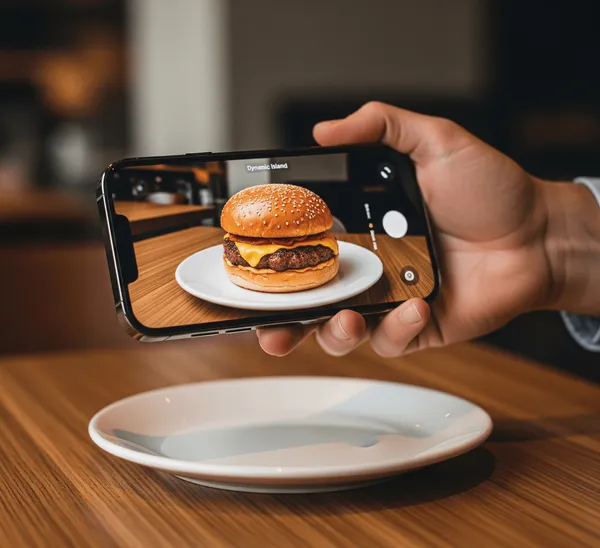
AR menus operate on the principle of transparency. By projecting a hyper-realistic 3D model of a dish onto a table via a smartphone, diners can move beyond the limitations of flat 2D photography.
Unlike traditional static images, which are often stylized by food photographers to look larger or more aesthetic than reality, AR models are generated from the actual composition of the dish. This technology offers three key advantages for the health-conscious diner:
- Scale Perception: AR allows users to view the dish in its true-to-life dimensions relative to their surroundings. Seeing a 3D model helps the brain process the actual volume of the meal.
- Ingredient Visibility: Users can rotate and inspect the dish, identifying the ratio of proteins to carbohydrates and vegetables. This level of visual granularity helps diners identify hidden "caloric bombs," such as heavy cream sauces or oversized portions of starches.
- Customization Simulation: Some advanced AR platforms allow users to view their meal with modifications. If a diner requests a dressing on the side or a smaller protein portion, the AR model can adjust accordingly, providing a better mental map of the caloric reduction.
Empowering Diners Through Informed Decision-Making
The transition toward digital, visual menus is part of a broader shift toward "mindful dining." When a diner knows exactly what to expect, they are less likely to experience the "fear of missing out" that often leads to ordering more food than necessary.
When Truebyte integrates AR technology into restaurant menus, the goal is to shift the power dynamic back to the customer. By removing the guesswork, diners can shift their focus from navigating an opaque menu to enjoying a meal that aligns with their personal nutritional framework.
This technology also assists those with specific dietary requirements or restrictions. For individuals monitoring their blood glucose or tracking macros, an AR preview acts as a visual verification that the meal meets their specific biological needs.
The Impact on Restaurant Efficiency and Waste
While the primary benefit of AR menus is for the diner, the impact on restaurant operations is equally significant. When guests are better informed about the portion sizes they are ordering, they are less likely to send food back or leave significant portions on their plate.
Data from the Sustainable Restaurant Association highlights that food waste is one of the biggest challenges in the hospitality sector. By setting accurate expectations, AR technology acts as a preventative measure.
When customers are confident in their choices, they spend less time debating the menu and more time enjoying the experience. This streamlined decision-making process reduces the cognitive load on the diner, leading to a more positive overall review of the establishment.
Integrating AR into the Dining Future
As AR technology becomes more ubiquitous, we are likely to see it evolve into a personalized experience. Imagine an AR menu that syncs with a health app on your smartphone, highlighting the specific items that fit within your daily caloric or macronutrient goals.
This level of integration transforms the menu from a simple list of offerings into a personalized nutrition assistant. It is a win-win scenario: the restaurant provides a cutting-edge, high-value service, and the diner gains complete control over their dietary choices.
As industry leaders like Truebyte continue to refine the fidelity of these 3D models, the line between the digital representation and the physical reality will become thinner. We are moving toward a future where "not knowing what you're getting" is a relic of the past.
Conclusion: Making Smarter Choices at the Table
Understanding portion sizes is the cornerstone of healthy eating, but for too long, the restaurant industry has relied on the ambiguity of text and the trickery of stylized photos to mask the true nature of what we eat.
Augmented Reality changes the narrative by putting the power of visualization directly into the diner's hands. By providing a clear, accurate, and interactive preview of a meal, AR menus allow us to move past the pitfalls of portion distortion and make choices that serve our health rather than simply filling our plates.
As this technology continues to scale, it will become the standard for any restaurant that values transparency and customer satisfaction. The next time you sit down to dine, look for the AR menu—it might just be the most important ingredient in your meal.