
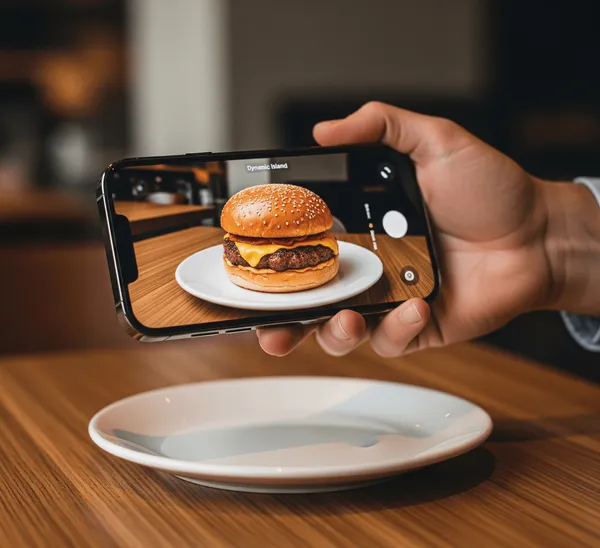
A large part of an order placed in a restaurant is shaped by the appearance of the food rather than its taste. This is not a habit, but the way the human brain works. People visualize the food in their minds before tasting it. The clearer this visualization, the stronger the decision.
At this exact point, a concept comes into play: Visual Hunger.
What is Visual Hunger?
Visual hunger is the brain producing a hunger and appetite response by perceiving food through visual stimuli. Scientific research shows that even just looking at a photo of food activates the brain regions associated with hunger.
That is:
- No taste
- No smell
- No physical contact
But the brain already starts deciding. That's why menu photos are effective, why food content on social media sees so much interest, and why the complaint "It didn't come as I expected" is so common.
The Biggest Problem on the Menu: Expectation Gap
A large part of the dissatisfaction experienced in restaurant dining stems from this reason: The perception difference between the expected food and the food that arrives.
This difference usually consists of reasons such as:
- The portion arriving smaller than expected
- The presentation in the photo not overlapping with reality
- Inability to estimate the space the food occupies on the table
And this situation affects not only customer satisfaction but also operational efficiency.
The Connection Between Wrong Orders and Food Waste
Every order placed with a wrong perception is a potential waste risk. When the customer does not like the food:
- They return it
- They want to change it
- They eat half and leave it
All of these scenarios mean food waste, loss of time, and increased costs. Whereas most of the time the problem is not the quality of the food, but the food not being described correctly.
Why Photos Are No Longer Enough
For many years, restaurants tried to solve this problem with menu photos. However, the photo has a significant shortcoming: It does not offer scale, does not give a sense of portion, and does not tell the real size of the food.
The same hamburger photo can be perceived completely differently by two different people. Because the human brain wants to see size within context.
Seeing Before Ordering: The Point That Changes the Decision Process
The expectation of modern users is now very clear: "I want to know the size and appearance of the food before I order."
This expectation generates:
- More conscious ordering
- Fewer surprises
- Higher satisfaction
The key point here is not technology, but clarity.
Visual Clarity Creates Trust
If a customer feels that they know what will come, the portion fits them, and there will be no surprises before ordering the food, their trust in that restaurant increases.
This trust returns as:
- Fewer returns
- Higher scores
- More repeat visits
Truebyte Approach: Eliminating Uncertainty
Truebyte's starting point is very simple: To eliminate the uncertainty between the menu and the customer.
The User:
- Scans the QR on the menu
- Before ordering
- Sees the size and appearance of the food on their phone screen
Thus, the decision becomes clearer, more conscious, and more satisfying.
Tangible Benefits for Restaurants
This approach is not just a "novelty" for restaurants. It provides directly measurable benefits:
- Decrease in wrong order rate
- Reduction in food waste
- Increase in customer satisfaction
- Strengthening in brand perception
And most importantly: Trust is formed between the customer and the restaurant.
Conclusion: You Eat with Your Eyes First, But Only If Shown Correctly
You really eat with your eyes first. But if not shown correctly, the eye is deceived. Restaurants that manage visual appetite correctly experience fewer problems, operate more sustainably, and offer a stronger experience.
Because the issue is no longer just making good food, but describing the food correctly.